


Managing microplastics in Clinical labs for future compliance
A single PCR test can use up to 30 grams of plastic1. Multiply that figure by the number of tests carried out each day in a clinical laboratory, and the scale of the environmental impact becomes clear.
Single-use plastic materials remain essential to clinical laboratory operations because they support sterility, safety, and analytical accuracy. However, the environmental implications of this dependence are increasingly recognized by laboratory professionals, as 84% of them are actively seeking ways to reduce the ecological footprint of their facilities2.
Although much attention has traditionally focused on visible laboratory waste such as pipette tips, tubes, plates, and packaging, concern is increasingly shifting toward microplastics. These particles, commonly referred to as microplastics, have long been identified as persistent environmental contaminants and are now receiving growing attention due to their potential impacts on ecosystems and human health3,4.
As scientific understanding advances, regulatory authorities are introducing stricter controls on the use and release of microplastics. Clinical and in vitro diagnostic (IVD) applications currently benefit from certain exemptions under existing legislation, but these exemptions are accompanied by reporting requirements and may eventually evolve into obligations that include active microplastic removal in a close future5.
Consequently, many clinical laboratories are beginning to evaluate their contribution to microplastic emissions and explore practical measures to reduce their environmental impact by better managing these pollutants.
Understanding microplastics in Clinical wastewater
Wastewater generated by clinical laboratories contains a complex and variable mixture of substances that reflects the diversity of testing procedures, reagents, consumables, and biological samples processed daily. In addition to pharmaceuticals, pathogens, and trace metals, laboratory effluent may also contain microplastics, creating additional challenges for wastewater management.
Microplastics are defined as insoluble plastic particles measuring less than 5 millimeters in diameter, while nanoplastics are considerably smaller and exist at the sub-micron level6. These contaminants are commonly categorized into two groups:
Primary microplastics are intentionally manufactured particles with distinct physical or chemical properties, designed for specific industrial or scientific functions.
Secondary microplastics result from the breakdown of larger plastic items through mechanical stress, chemical exposure, or environmental degradation.
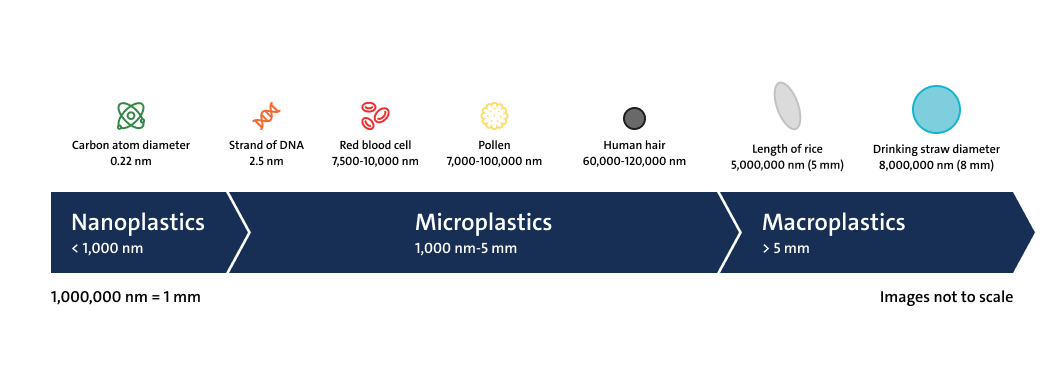
Figure adapted from Illinois Environmental Protection Agency.7
Within clinical laboratory settings, both categories can enter wastewater streams during routine analytical operations8.
Primary microplastics may be introduced during assay processing, equipment cleaning cycles, and system flushing procedures. Examples include:
-
Polymer beads used in turbidimetric immunoassays.
-
Microparticle-containing calibrators and quality control materials that simulate biological samples.
-
Bead-based capture technologies employed during sample preparation and analytical workflows.
Secondary microplastics are generated through the gradual deterioration of laboratory components and consumables. Common sources include:
-
Mechanical contact or chemical exposure of disposable items such as pipette tips, cartridges, microplates, and probes releasing plastic particles.
-
Progressive degradation of reusable components, including tubing, reservoirs, and valves exposed to repeated thermal, mechanical, or chemical stress.
If these particles are not captured before wastewater is discharged, clinical laboratories contribute to the release of microplastics into downstream water systems, which could lead to serious consequences on the environment.
Assessing the environmental and health implications of microplastic pollution
One of the primary concerns associated with microplastics is their persistence. Unlike many other contaminants, they do not readily decompose and can accumulate in rivers, oceans, wildlife, and even human tissues over time. Their widespread presence raises concerns about ecological disruption, particularly within aquatic environments that form the foundation of many food chains9. In addition, microplastics can act as carriers for other pollutants, including chemical compounds and microorganisms that attach to particles’ surfaces and can then be transported through water systems10,11.
Human exposure to microplastics occurs through several routes, including drinking water, food consumption, and inhalation, which makes it a public health matter. As research is ongoing, laboratory studies have linked microplastic exposure to cellular stress responses and inflammatory effects. Emerging evidence also suggests that microplastics may provide favorable surfaces for microbial colonization, potentially contributing to the spread of antimicrobial resistance10,12.
As awareness of these risks continues to grow, future regulations are expected to place increasing emphasis on prevention and removal strategies rather than reporting alone.
Regulatory requirements: what applies today and what lies ahead
Within the European Union, microplastic regulation is influenced by the interaction between the REACH framework, governing intentionally added synthetic polymer microparticles, and Regulation (EU) 2017/746, relating to in vitro diagnostic medical devices13.
Current legislation restricts certain categories of intentionally added microplastics while maintaining exemptions for specific clinical and IVD applications. These exemptions generally cover products and accessories such as reagent kits, test cartridges, calibrators, controls, and sample preparation consumables routinely used in diagnostic laboratories.
Nevertheless, exempt status does not eliminate regulatory responsibilities for clinical labs. Beginning in 2026 in the EU, manufacturers and downstream users of products containing intentionally added synthetic polymer microparticles will be required to submit annual reports to ECHA, detailing estimated emissions and measures implemented to reduce environmental release14.
The progressive rollout of REACH requirements for microplastics reflects an evolving regulatory landscape. Although implementation schedules differ across regions, the underlying trend remains the same: regulatory focus is gradually shifting beyond reporting obligations toward the adoption of effective control and mitigation measures.
As regulations continue to evolve, existing exemptions for clinical labs focusing on transparency and documentation are likely to undergo further review. Many industry experts therefore recommend that laboratories adopt proactive management strategies rather than waiting for future compliance obligations to emerge15.
For laboratory leaders, this means reassessing wastewater management practices, strengthening environmental monitoring programs, and ensuring sufficient flexibility to accommodate future reporting and mitigation requirements. Environmental, Social, and Governance (ESG) initiatives are also expected to place greater emphasis on managing and reducing microplastic emissions.
Preparing for the next phase of regulation
For clinical laboratories, this represents more than a compliance challenge, it is an opportunity to adopt proactive wastewater management that supports sustainability and future-proofs operations. By integrating microplastic removal into your routine today, you position your laboratory as an leader in responsible diagnostics.
Ready to act?
-
Learn more about the Medica Biox treatment solution.
-
Download our new Risk Guide to master water-related risk management
*Trademark of Veolia; may be registered in one or more countries.
References
1. Mansuy JM, Migueres M, Trémeaux P, Izopet J. Will the latest wave of the COVID-19 pandemic be an ecological disaster? There is an urgent need to replace plastic by ecologically virtuous materials. Health Sci Rep. 2022;5(5):e703. doi:10.1002/hsr2.703
2. Black D. Twelve reasons for labs to go greener. Chemistry World. Accessed February 12, 2026. https://www.chemistryworld.com/opinion/twelve-reasons-for-labs-to-go-greener/4016387.article
3. Ziani K, Ioniță-Mîndrican CB, Mititelu M, et al. Microplastics: A Real Global Threat for Environment and Food Safety: A State of the Art Review. Nutrients. 2023;15(3):617. doi:10.3390/nu15030617
4. Winiarska E, Jutel M, Zemelka-Wiacek M. The potential impact of nano- and microplastics on human health: Understanding human health risks. Environ Res. 2024;251:118535. doi:10.1016/j.envres.2024.118535
5. Commission Regulation (EU) 2023/2055 - Restriction of microplastics intentionally added to products - Internal Market, Industry, Entrepreneurship and SMEs. Accessed February 10, 2026. https://single-market-economy.ec.europa.eu/sectors/chemicals/reach/restrictions/commission-regulation-eu-20232055-restriction-microplastics-intentionally-added-products_en
6. Cole M, Lindeque P, Halsband C, Galloway TS. Microplastics as contaminants in the marine environment: A review. Mar Pollut Bull. 2011;62(12):2588-2597. doi:10.1016/j.marpolbul.2011.09.025
7. Microplastics. Accessed February 12, 2026. https://epa.illinois.gov/topics/water-quality/microplastics.html
8. How Medical Devices Produce Microplastics. Plastics Today. Accessed February 11, 2026. https://www.plasticstoday.com/medical/microplastics-in-medical-devices-understanding-sources-and-potential-risks
9. A global estimate of multiecosystem photosynthesis losses under microplastic pollution | PNAS. Accessed February 11, 2026. https://www.pnas.org/doi/10.1073/pnas.2423957122
10. Stevenson EM, Buckling A, Cole M, Hayes A, Lindeque PK, Murray AK. Sewers to Seas: exploring pathogens and antimicrobial resistance on microplastics from hospital wastewater to marine environments. Environ Int. 2025;206:109944. doi:10.1016/j.envint.2025.109944
11. Rafa N, Ahmed B, Zohora F, et al. Microplastics as carriers of toxic pollutants: Source, transport, and toxicological effects. Environ Pollut. 2024;343:123190. doi:10.1016/j.envpol.2023.123190
12. Microplastics and our health: What the science says. News Center. Accessed February 11, 2026. https://med.stanford.edu/news/insights/2025/01/microplastics-in-body-polluted-tiny-plastic-fragments.html
13. European Chemicals Agency (ECHA). REACH Restriction of Synthetic Polymer Microparticles: (Entry 78 of Annex XVII REACH, as Introduced by Commission Regulation (EU) 2023/2055). Accessed February 11, 2026. https://webgate.ec.europa.eu/circabc-ewpp/d/d/workspace/SpacesStore/7f416aa0-21ab-4b9e-9809-b5d7087c9501/download
14. ECHA. ECHA ready to receive reports on microplastics emissions. ECHA. Accessed February 12, 2026. https://echa.europa.eu/-/echa-ready-to-receive-reports-on-microplastics-emissions
15. Reach24h. EU Microplastic Emission Reporting System Officially Launched: First Submission Due by May 2026 - REACH24H. Accessed February 12, 2026. http://en.reach24h.com/news/industry-news/chemical/eu-microplastic-emission-reporting-system-launched